
Blog
What Makes Pakistani Karahi Different from Indian Curry

Two cuisines. One subcontinent. Centuries of distinct culinary tradition — and a world of difference in the pot.
Walk into any South Asian restaurant and you’ll likely find both karahi and curry on the menu. To the uninitiated, both are spiced, slow-cooked dishes served with naan or rice. But to anyone who has grown up eating them — or cooking them — the difference is unmistakable. Pakistani karahi and Indian curry represent two distinct culinary philosophies, shaped by geography, culture, and centuries of regional cooking traditions.
At Cafe Taj, we serve authentic Pakistani karahi the way it was meant to be made: bold, minimal, and deeply aromatic. Here’s a deep dive into what truly sets these two beloved dishes apart.
1. The Origins: Where They Come From
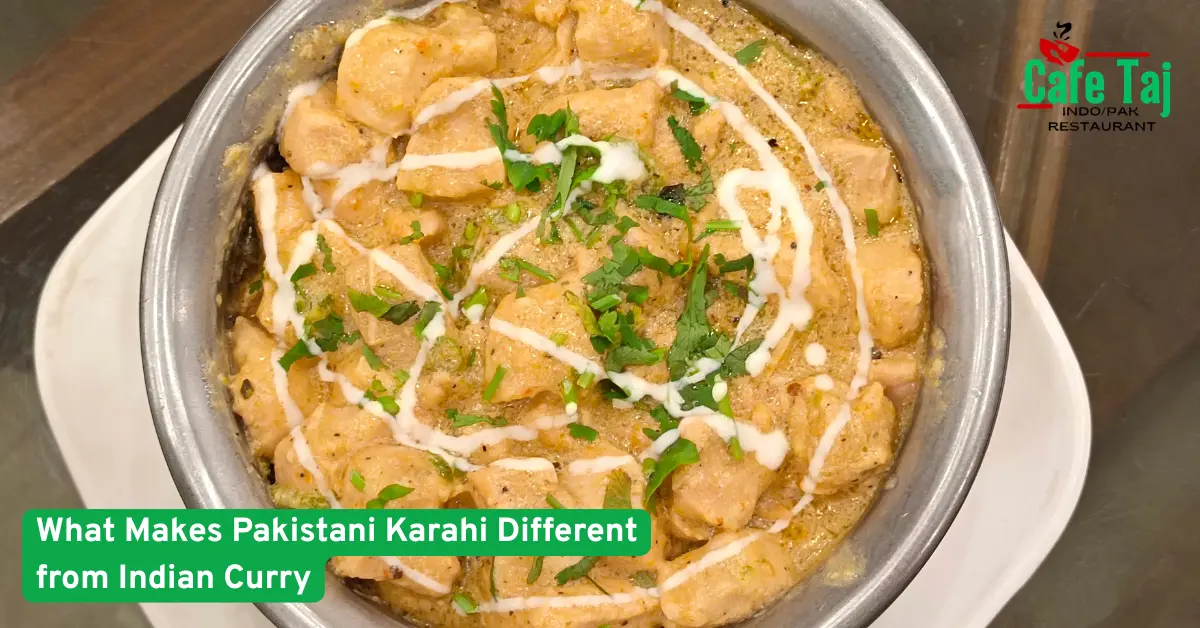
Pakistani karahi takes its name directly from the cooking vessel it’s prepared in — the karahi, a thick, round-bottomed iron wok that looks much like a Chinese wok but is used very differently. The dish itself is native to the North-West Frontier (now Khyber Pakhtunkhwa) and Punjab regions of Pakistan, with Peshawari karahi being among the most celebrated variations in the world.
Indian curry, on the other hand, is not a single dish — it’s a category. The word “curry” is largely a British invention, used as a blanket term to describe a huge variety of South Indian, North Indian, and regional gravies. From Kerala’s coconut-based fish curries to Delhi’s creamy butter chicken, Indian curry encompasses hundreds of distinct recipes.
2. The Cooking Vessel Makes All the Difference
The heavy iron karahi retains and distributes heat unevenly in a way that creates intense, high-heat cooking conditions. This allows the tomatoes to blister and char slightly, the fat to separate from the meat naturally, and the spices to bloom in a dry, aggressive manner rather than simmer gently in water or stock.
Most Indian curries are prepared in a regular pot or pan with added liquid — water, stock, or coconut milk — creating a sauce that’s fundamentally different in texture and fat content. The karahi method is closer to a dry braise: high heat, minimal liquid, maximum flavor concentration.
3. The Spice Profiles: Restraint vs. Complexity
This is perhaps the most defining difference. Pakistani karahi uses a very short list of spices — typically fresh tomatoes, ginger, garlic, green chilies, black pepper, and coriander. That’s largely it. The simplicity is intentional. The flavors of the meat (usually goat, chicken, or beef) are meant to shine through, not be masked by a long list of ground powders.
Indian curries, by contrast, celebrate spice complexity. A classic North Indian chicken curry might include cumin, cardamom, cloves, bay leaves, cinnamon, coriander powder, turmeric, garam masala, and dried fenugreek leaves — all in a single dish. Southern Indian curries go even further, incorporating mustard seeds, curry leaves, tamarind, and coconut in intricate layered profiles.
Pakistani Karahi
- Fresh tomatoes (high volume)
- Fresh ginger & garlic
- Green chilies
- Black pepper
- Coriander (fresh + seeds)
- Minimal or no water
- Fat-separated finish
Indian Curry
- Onion-tomato masala base
- Turmeric, cumin, coriander powder
- Garam masala blend
- Often cream or yogurt
- Dried spices, bay leaves
- Stock or water added
- Smooth, saucy consistency
4. The Role of Onions
Nearly every Indian curry begins with deeply caramelized onions — the bhuna process — which forms the foundation of the gravy. Onions cooked low and slow until golden-brown create a sweet, deeply savory base that defines the dish’s flavor from the ground up.
Traditional Pakistani karahi uses no onions at all, or only as a minor garnish. This is one of the most surprising facts for people new to the dish. Without onions, the karahi’s flavor base relies entirely on the reduction of fresh tomatoes and the browning of meat, creating a more acidic, brighter, and less sweet flavor profile.
5. Texture, Fat, and Finish
A well-made Pakistani karahi will show oil or fat floating on the surface — this is called tarka separation and is considered a sign of quality, not excess. It means the tomatoes have fully cooked down and the spices have properly bloomed in the fat. The gravy is thick, clingy, and deeply reduced.
Indian curries span a much wider range of textures: some are thin broths, others are thick cream-based sauces. Dishes like dal makhani or korma are rich and silky, while regional curries like rasam are nearly watery. The diversity within Indian curry alone is staggering.
6. Regional Pride and Identity
Karahi in Pakistan isn’t just food — it’s identity. Restaurants in Lahore, Peshawar, and Karachi compete fiercely for the title of “best karahi in the city.” Families pass down their karahi technique across generations with the same seriousness as a family heirloom. You’ll find roadside dhabas in Pakistan where a single massive karahi has been bubbling over a wood fire for hours before service even begins.
Indian curry culture is equally passionate, but expressed differently — through the endless regional variations, the use of locally sourced spices, and the integration of curry into daily home cooking in ways that karahi typically is not.
7. Which One Should You Try?
Honestly? Both. They are not rivals — they are cousins with very different personalities. If you love bold, meat-forward, intensely savory flavors with minimal sweetness, Pakistani karahi is going to change your life. If you prefer complex, layered spice experiences with creamy, sauce-rich gravies, Indian curry is your world to explore.
At Cafe Taj in Houston, we specialize in bringing you the authentic Pakistani karahi experience — the kind made in a proper iron wok, with real tomatoes, generous ginger, and the patience that great karahi demands.
Frequently Asked Questions
Is Pakistani karahi spicier than Indian curry?
Not necessarily spicier, but differently hot. Karahi uses fresh green chilies and black pepper for heat, which is sharp and immediate. Many Indian curries use red chili powder, which builds heat more gradually. Peshawari-style karahi can actually be quite mild and aromatic.
Can karahi be made with chicken or only goat?
Both are traditional. Chicken karahi (murgh karahi) is the most common, while goat/mutton karahi is considered the premium, celebratory version. Beef karahi is also popular in Pakistan. At Cafe Taj, we offer both chicken and goat karahi options.
Does karahi have onions?
Authentic Pakistani karahi typically does not use onions in the cooking process. This distinguishes it from most Indian curries. Some modern or restaurant variations add a small amount of onion, but traditional karahi is an onion-free dish.
What do you eat with karahi?
Karahi is traditionally eaten with fresh naan or tandoori roti — the bread is used to scoop up the thick gravy and meat. It’s less commonly served with rice than Indian curry, although that pairing works too.
Is karahi healthier than Indian curry?
Karahi uses fewer processed ingredients and no cream or milk, making it naturally lower in certain fats. However, it is cooked with a generous amount of oil or ghee. Indian curries vary widely — some are very light (dal, vegetable curries), while others like korma or butter chicken are rich in cream and butter.
Where can I eat authentic Pakistani karahi in Houston?
Cafe Taj at 10730 W Bellfort Ave, Houston, TX 77099 specializes in authentic Indo-Pak cuisine including our signature chicken and goat karahi, made fresh using traditional methods.
Ready to taste the real difference? Come experience our signature karahi — made fresh, made bold, made the Cafe Taj way.